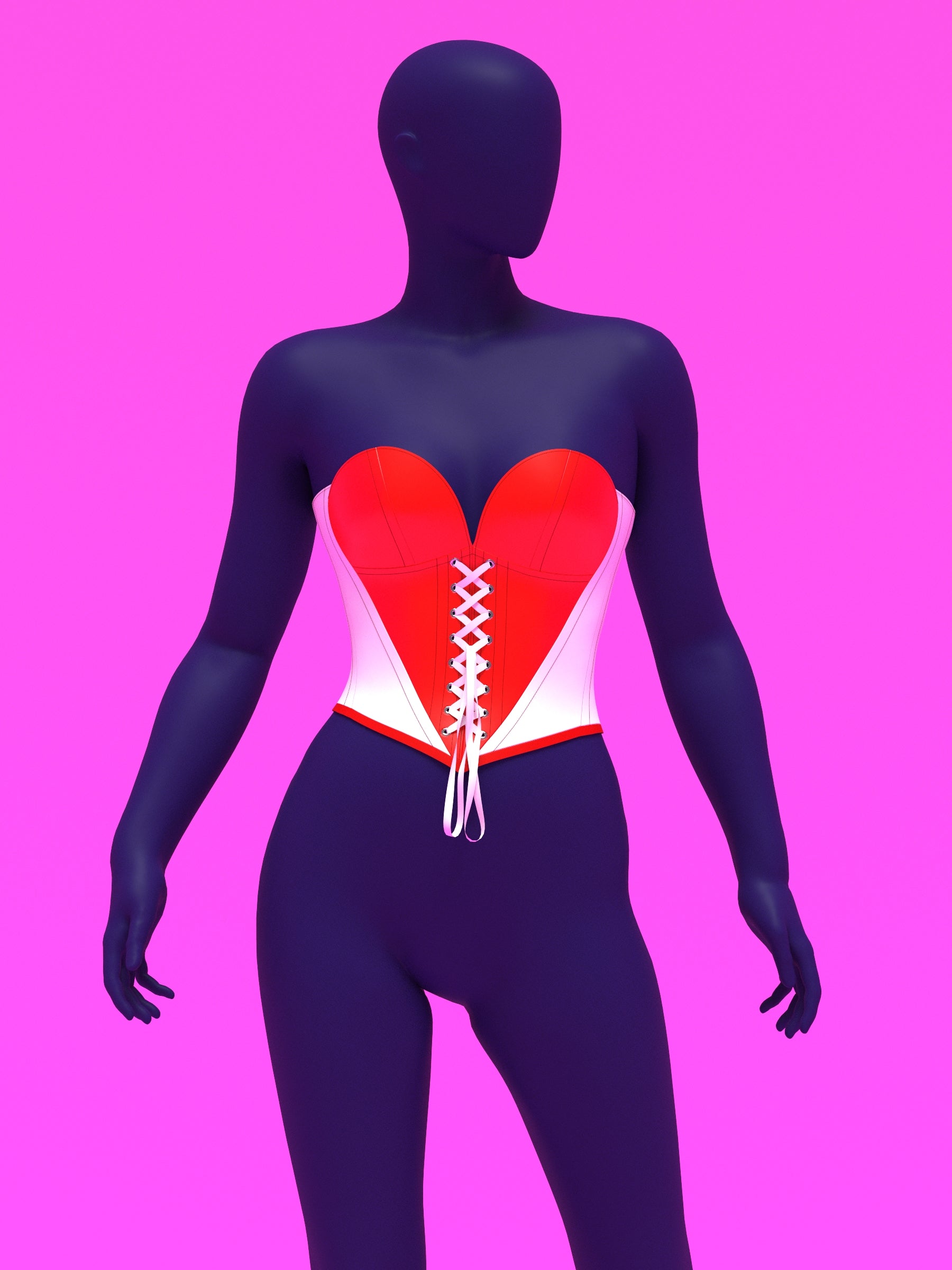
Cómo coser un corsé con forma de corazón
Saltar a instruccionesDescripción general
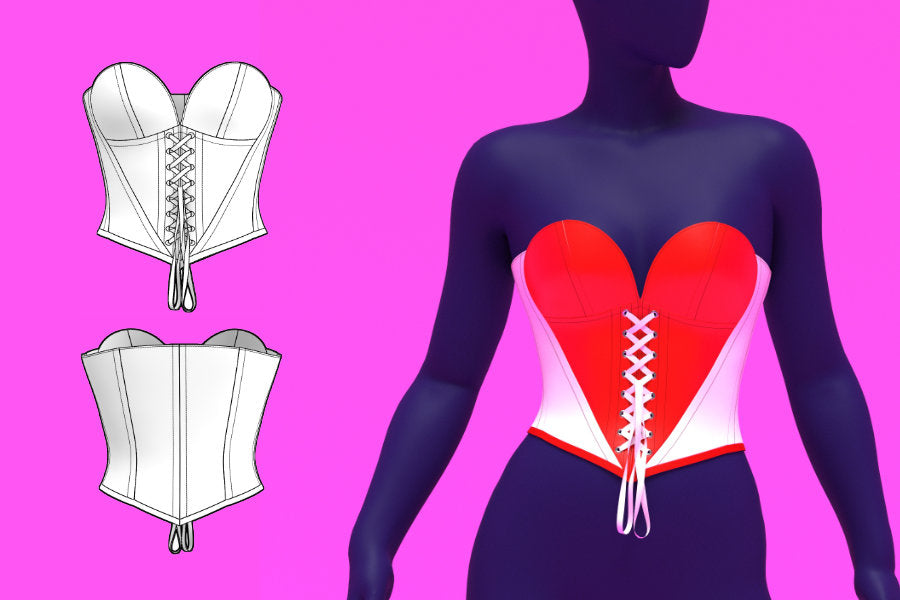
Aprende a coser un top de corsé en forma de corazón con opciones de cordones en la parte delantera o trasera. Este tutorial de costura paso a paso abarca la preparación de la tela, las ballenas, el forro, los ojales y las técnicas de acabado para un acabado impecable y estructurado.
Yardas de tela
La tabla de telas a continuación muestra el metraje recomendado según el tipo de tela. La tela A corresponde a la tela del corazón delantero central y la tela B a la tela de los laterales y la espalda del corsé. El forro no está incluido; repita el procedimiento para la tela del forro. El metraje de tela a continuación corresponde a rollos de tela de 54" o más de ancho.
| Tamaño | Tela A | Tela B |
|---|---|---|
| XS | 0,5 años | 0,5 años |
| S | 0,5 años | 0,5 años |
| METRO | 0,5 años | 0,5 años |
| L | 0,5 años | 0,5 años |
| SG | 0,5 años | 0,5 años |
| 2XL | 0,5 años | 0,5 años |
Telas y artículos de mercería
- Piel sintética no elástica, vinilo, coutil, lona o mezclilla, algodón, mezcla de poliéster
- Varillas de plástico cosibles de 6 mm
- Cinta al bies doblada dos veces
- Ojales o ojales para atar cordones
- Cinta, cordón o cordones de zapatos
- Dos pequeñas tiras de entretela termoadhesiva para la zona del ojal trasero
Detalles de tallas
Este corsé está diseñado en nuestras tallas exclusivas para drag queens, desde la XS hasta la 2XL, y está creado para adaptarse a cuerpos con curvas y hombros, brazos y piernas más anchos. Si bien este patrón está pensado para artistas drag, puede ser usado por cualquier persona, independientemente de su género, que cumpla con las medidas indicadas a continuación.
| Tamaño | Pecho masculino | Cofre de arrastre (acolchado) | Cintura masculina | Cintura de arrastre (con corsé) | Cadera masculina | Cadera de arrastre (acolchada) | Altura |
|---|---|---|---|---|---|---|---|
| XS | 33-35 | 36-38 | 27,5-29,5 | 24,5-26,5 | 32,5-34,5 | 38-40 | 70 |
| S | 35-37 | 38-40 | 29,5-31,5 | 26,5-28,5 | 34,5-36,5 | 40-42 | 70 |
| METRO | 39-41 | 42-44 | 33,5-35,5 | 30,5-32,5 | 38,5-40,5 | 44-46 | 70 |
| L | 43-45 | 46-48 | 37,5-39,5 | 34,5-36,5 | 42-44 | 47,5-49,5 | 70 |
| SG | 47-49 | 50-52 | 42,5-44,5 | 39,5-41,5 | 45-47 | 50,5-52,5 | 70 |
| 2XL | 51-53 | 55-57 | 47,5-49,5 | 44,5-46,5 | 48-50 | 54,5-56,5 | 70 |
Instrucciones de costura
Color Guide

Design Style
Before you begin, choose your design style. This heart-shaped corset top can be laced at the center front, the center back, or both. Select the option that best suits your look, or experiment with different lace-up placements.
Fabric Pieces
This pattern includes seven paper pattern pieces. Use these pieces to cut out your fabric before starting construction.
Pattern pieces 1 through 7 should each be cut as two mirrored pieces for the shell and two mirrored pieces for the lining.

Interfacing
Depending on your fabric choice, you may need to add interfacing. Faux leather or vinyl shells typically do not require interfacing. Lightweight non-stretch cotton or polyester fabrics usually benefit from fusible interfacing.
If needed, use the same pattern pieces to cut your interfacing. You may remove the seam allowance if desired, then fuse the adhesive side to the wrong side of each shell fabric piece. This step is optional and depends on the level of structure you want.

Bust Cup Assembly
We can now begin sewing the pieces together. Start with pattern pieces 1 and 2, which form the bust cups. Sew piece 1 to piece 2 along the edge labeled A, aligning the notches. Use a straight stitch with a 1/2 inch seam allowance.
After sewing, you may press the seam allowance open to both sides or press it toward piece 2. If desired, topstitch over the seam allowance to create a boning channel. Boning is not required in the bust cup area.

Joining the Bust to the Bodice
Sew the assembled pieces 1 and 2 to the top edge of pattern piece 3 with right sides facing. Align the notches and sew using a straight stitch with a 1/2 inch seam allowance.
After sewing, press the seam allowance downward toward piece 3 and topstitch if desired.

Side Panel Assembly
Next, assemble the remaining corset pieces. Sew pattern piece 4 to 5 along the edge labeled D. Then sew 5 to 6 along edge E, and 6 to 7 along edge F. Use the same method as before with right sides facing and a straight stitch using a 1/2 inch seam allowance.
After each seam, press the seam allowance away from the center front. Topstitch the seam allowance to create boning channels. You may add more or fewer boning channels depending on your desired structure.

Then, sew pattern piece 4 to the side of the center front heart assembly, pieces 2 and 3, along the edge labeled C. This completes one half of the corset.
Repeat all previous steps to assemble the second half of the corset.

Center Seam Assembly
center back. The side that will not be laced should be sewn together with right sides facing.
For example, if you choose a center front lace-up, sew the two center back pieces, pattern piece 7, together along the center back edge using the same stitching method as before.

Lining Assembly
Once the shell is complete, repeat the same assembly steps using the lining pieces. The lining does not require boning channels. However, for added structure, edge stitch the seam allowances down.
Stitch as close to each seam as possible to keep the lining flat and secure.

Attaching Shell and Lining
Place the shell and lining right sides facing each other. Pin and clip them securely, making sure all seams and edges align accurately.
Sew along the top edge, then continue down the side of the lace-up edge, either center front or center back depending on your design choice. When sewing curves or corners, pivot the needle as needed or sew in short sections instead of one continuous seam.

Once sewn, turn the corset right side out and press all edges flat. Edge stitch along the newly sewn seams to secure the shell and lining and create a clean finish.

Boning and Lace-Up Channels
Along the lace-up edge, either center front or center back, create boning channels by topstitching three vertical channels. The center channel should be wide enough for eyelets. The two outer channels should be sized for boning. Repeat this on both sides of the lace-up edge.

Next, measure and cut all remaining bones for the corset. Each bone should be cut about 1 inch shorter than the full length of its seam tunnel to allow room for hemming at the bottom. If using plastic or sew-in boning, round the ends or tape or melt them so they do not puncture the fabric before inserting them into the channels.

Bottom Edge Binding
Once the boning is inserted, finish the bottom edge with bias tape or bias binding. Unfold the bias tape and place it right sides facing the right side of the corset’s bottom edge. Sew it in place using a 1/2 inch seam allowance around the entire bottom edge.
After sewing, fold the bias tape over to the wrong side, fold the raw edge under, and topstitch in place all around the bottom edge. At the lace-up edge, fold the corners neatly before topstitching to create a clean finish.

Eyelets and Lacing
Install the eyelets along the lace-up edge using the placement guides on the paper pattern, or adjust the number as desired. Eyelets should always be placed in even pairs, such as 6, 8, 10, or 12, and aligned within the center channel.
Use your eyelet tool to set the eyelets in place. Once installed, lace up the corset using your preferred method, such as a bunny ear lace or another corset lacing style.

Obtén el patrón